
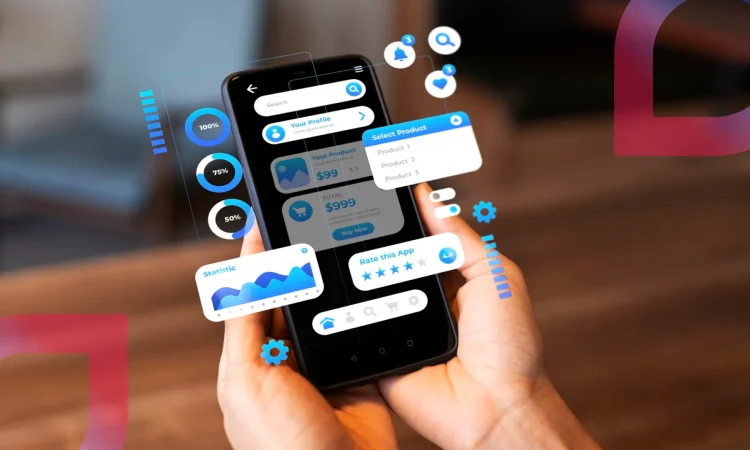
Mobile app development is the specialized process of creating software for smartphones and tablets. In 2026, the industry is split between Native development (using Swift for iOS or Kotlin for Android) and Cross-platform frameworks like Flutter or React Native, which allow developers to write one codebase for both platforms. Successful development now requires a heavy focus on “cloud-native” integration and AI-driven user experiences.
The mobile app market is enormous – over 5 million apps exist across the App Store and Google Play, generating over $500 billion in revenue annually. Getting into mobile development today is more accessible than ever: free tools, extensive documentation, and thriving communities mean a determined beginner can build and publish their first app within weeks of starting to learn.
Types of Mobile Apps
| Type | Description | Pros | Cons |
|---|---|---|---|
| Native iOS | Built specifically for Apple devices using Swift/Xcode | Best performance; full iOS API access | Only works on Apple; separate codebase |
| Native Android | Built for Android using Kotlin in Android Studio | Best Android performance; full API access | Only works on Android; separate codebase |
| Cross-Platform | One codebase for both iOS and Android (React Native, Flutter) | Faster development; one codebase | Slightly lower performance; occasional platform quirks |
| Progressive Web App (PWA) | Web app that behaves like a mobile app | No app store needed; any device | Limited device API access; no app store presence |
| Hybrid App | Web technologies wrapped in a native shell (Ionic, Cordova) | Reuses web skills; one codebase | Older approach; largely replaced by React Native/Flutter |
iOS vs Android vs Cross-Platform
| Factor | iOS (Swift) | Android (Kotlin) | Cross-Platform (Flutter/RN) |
|---|---|---|---|
| Language | Swift | Kotlin | Dart (Flutter) / JavaScript (React Native) |
| IDE | Xcode (Mac only) | Android Studio | VS Code or Android Studio |
| Performance | Excellent | Excellent | Very Good (Flutter near-native) |
| Learning curve | Medium | Medium | Medium (easier if you know JS for RN) |
| Time to market | Slower (one platform) | Slower (one platform) | Faster (both platforms at once) |
| Best for | Premium apps; iOS-first products | Large Android market focus | Startups; MVPs; budget-conscious projects |
The App Development Process
- Step 1 – Idea and validation: Define the problem your app solves; research competitors; validate demand.
- Step 2 – Define requirements: What features are essential for version 1? Keep scope small.
- Step 3 – Design: Create wireframes and UI mockups (Figma is the industry standard tool).
- Step 4 – Development: Write the code; build features iteratively.
- Step 5 – Testing: Unit tests, device testing, beta testing with real users (TestFlight for iOS, Firebase for Android).
- Step 6 – Launch: Submit to App Store and/or Google Play; each has a review process.
- Step 7 – Iterate: Gather user feedback; update and improve based on real usage.
Programming Languages Used
| Language | Platform | Difficulty | Best For |
|---|---|---|---|
| Swift | iOS | Medium | Native iOS development; excellent performance |
| Kotlin | Android | Medium | Native Android; modern and concise |
| Dart | Flutter (cross-platform) | Medium | Cross-platform; near-native performance |
| JavaScript | React Native (cross-platform) | Lower (if JS known) | Cross-platform; large ecosystem |
| Java | Android (legacy) | Medium-High | Older Android codebases; enterprise |
| Objective-C | iOS (legacy) | High | Maintaining legacy iOS apps only |
Cost of Building a Mobile App
| App Type | DIY Cost | Freelancer Cost | Agency Cost |
|---|---|---|---|
| Simple app (calculator, to-do list) | $0 (your time) | $3,000-$10,000 | $15,000-$30,000 |
| Mid-complexity (social features, API) | $0 (your time) | $15,000-$50,000 | $50,000-$100,000 |
| Complex app (marketplace, real-time) | $0 (your time) |
No-Code vs Traditional Development
No-code platforms like Bubble, Adalo, and Glide allow people to build functional apps without writing code. They’re genuinely useful for MVPs, internal tools, and simple consumer apps. The limitations appear when you need complex custom logic, high performance, or features the platform doesn’t support. For serious, scalable applications, traditional code remains the standard – but no-code is an excellent starting point.
How to Get Started as a Beginner
- Choose Flutter or React Native as your starting point – cross-platform means more reach per hour of learning.
- Free resources: Flutter’s official docs are excellent; Meta’s React Native tutorials; freeCodeCamp on YouTube.
- Build something small first – a weather app, a to-do list, a simple calculator. Finish it and publish it.
- Developer accounts: Apple charges $99/year; Google charges a one-time $25 fee for Play Console.
Mobile app development is genuinely learnable by anyone willing to put in consistent effort. The first app is the hardest – not because of the code, but because of the sheer number of new concepts. Once you’ve shipped one app, every subsequent one gets faster and more intuitive.