

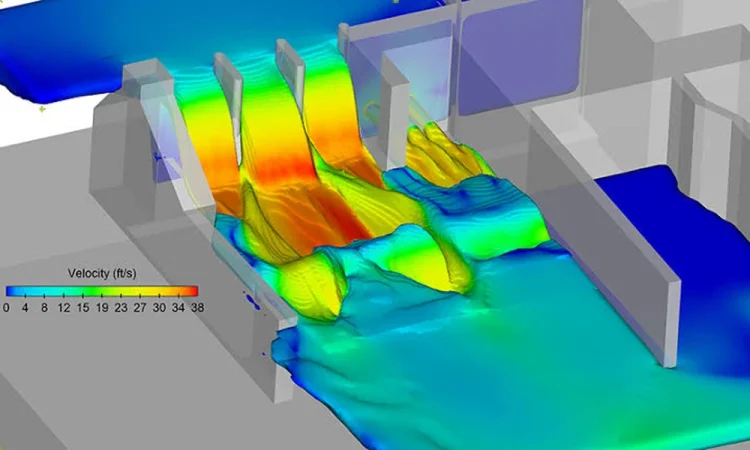
Computational fluid dynamics (CFD) is a way of using computers to study how liquids and gases move. It uses math and computer calculations to understand things such as pressure, temperature, speed, and flow. With the help of cfd software, engineers can study how fluids behave without having to test every design in the real world. CFD is used in many areas, including airplanes, cars, energy systems, and healthcare. It helps engineers understand fluid behavior, improve designs, solve problems, and create safer and more efficient products.
What Is Computational Fluid Dynamics?
Computational fluid dynamics is based on the basic rules of physics that describe how fluids move. These rules include the conservation of mass, momentum, and energy. They help computers calculate what happens to a fluid as it moves through or around an object.
Fluids are part of almost everything around us. Air allows us to breathe and helps airplanes stay in the air. Water moves through pipes, rivers, and machines. Even the movement of air through our vocal cords helps us produce sound when we speak. Because fluids are involved in so many natural and industrial processes, being able to study their movement is useful in many fields.
CFD can also reduce the need for physical testing. Instead of building several versions of a product and testing each one, engineers can first use a computer model to see how a design may perform. The results can then help them make changes before creating a physical product.
Examples of CFD Applications
CFD is used in different industries because it can study both fluid movement and heat transfer. It can also show how changes in fluid flow can affect a product or system.
Aerospace and Defense
CFD is widely used in the aerospace industry to study how air moves around airplanes, wings, rockets, and other aircraft. Engineers can use simulations to study lift, drag, pressure, and airflow. This can help them improve aircraft designs and reduce fuel use.
CFD can also be used inside an aircraft. For example, engineers can study how air moves through the cabin and how heat is distributed. This can help with cabin comfort and air quality. Other applications include aircraft cooling systems, engine airflow, external aerodynamics, and cabin heating and cooling.
Automotive
Cars also depend on the movement of air and heat. CFD can help engineers study airflow around a vehicle to improve its design. Better airflow can reduce drag and may help improve fuel efficiency.
CFD is also useful for electric vehicles. Engineers can study the temperature of batteries, electric motors, and other parts. Proper cooling is important because too much heat can reduce battery performance and may create safety risks. CFD can also be used to study motor cooling, gearbox lubrication, sensors, and noise caused by airflow.
Energy and Hydrogen
CFD has an important role in the development of cleaner energy systems. Hydrogen, for example, can be studied through different stages, including production, storage, transportation, and use.
Engineers can use CFD to study how hydrogen and other fuels behave in engines and fuel cells. These simulations can help researchers understand how different systems work and find ways to improve their performance.
Healthcare
CFD is also used in healthcare and medical research. It can help researchers study how blood moves through blood vessels and how air moves through the lungs and other parts of the respiratory system.
The technology can also support the development of medical devices. By studying fluid movement inside or around a device, researchers can better understand how it may work before testing it in real situations.
How CFD Works and Its Challenges
CFD works by turning a real fluid problem into a computer model. The model is then divided into many small sections so that the computer can calculate what happens in each area. The results from these calculations can then be used to understand the overall flow.
Main Steps in a CFD Simulation
The first step is to identify the area where the fluid will be studied. This is called the fluid flow domain. It may represent the air around an airplane, the water moving through a pipe, or the air flowing through a ventilation system. A computer-aided design (CAD) model is often used to create this area.
The second step is to create a mesh. A mesh divides the flow area into many smaller cells. The computer uses these cells to calculate the movement and properties of the fluid. A finer mesh can provide more detail, although it can also require more computer power and time.
The third step is to apply the equations that describe the fluid. The computer calculates values such as pressure, velocity, temperature, and density in the different cells.
For large simulations, high-performance computing can also be used. The work can be divided between several processors or computers. This allows large and complex CFD simulations to be completed faster.
Challenges of CFD
Although CFD is very useful, studying fluid flow on a computer can be difficult. Real fluids can behave in complicated ways, especially when different physical effects happen at the same time.
One challenge is the interaction between fluids and solid objects. For example, when wind pushes against a tree, the wind can make the tree move, while the movement of the tree changes the way the wind flows. Engineers need to consider both the fluid and the solid structure when studying this type of problem.
Another challenge is turbulence. Turbulent flow can change quickly and can be difficult to predict. It can affect pressure, heat transfer, and the movement of the fluid. Because of this, engineers often need special models to represent turbulence in a CFD simulation.
Fluid flow can also change over time. For example, airflow around a moving car is not exactly the same from one moment to another. When these changes are important, engineers may need to perform a time-based simulation. This usually requires more computer power and takes longer to complete.
History of Computational Fluid Dynamics
The development of CFD has taken place over many decades. In the early 20th century, scientists developed mathematical equations to describe fluid movement. The Navier-Stokes equations became an important foundation for understanding fluid behavior.
The development of computers in the 1950s and 1960s changed the field. Computers made it possible to perform calculations that would have been too difficult or time-consuming to complete by hand.
During the 1960s and 1970s, numerical methods became more advanced. Researchers could divide a flow area into smaller sections and calculate fluid properties within each section. This made it possible to study more complex shapes and flow conditions.
Today, high-performance computing has made CFD even more powerful. Modern computers can process very large amounts of information, allowing engineers to study detailed models of aircraft, vehicles, engines, buildings, and other systems.
The Governing Equations of CFD
CFD depends on several basic equations that describe how fluids behave. These equations are based on three important ideas: the conservation of mass, momentum, and energy.
Conservation of Mass
The conservation of mass means that mass cannot simply disappear. In a fluid system, the amount of fluid entering and leaving an area must be accounted for. This principle is commonly represented by the continuity equation.
Conservation of Momentum
Momentum is related to the movement of the fluid. The momentum equation considers forces that affect the fluid, such as pressure, gravity, and friction. It helps the computer determine how the speed and direction of a fluid may change.
Conservation of Energy
Energy also needs to be accounted for in a fluid system. The energy equation can be used to study changes in temperature and heat. It considers energy entering or leaving the system through processes such as heat transfer.
Together, these equations give engineers a way to describe fluid movement and other changes within a computer simulation.
The Future of CFD
CFD continues to improve as computers and simulation tools become more powerful. One major development is the use of graphics processing units (GPUs) to perform large numbers of calculations at the same time.
Using multiple GPUs can make some CFD simulations much faster. This can allow engineers to study larger models, test more designs, and get results in less time.
As computing power continues to grow, CFD is expected to remain an important tool for engineering and research. It can help reduce the time needed for testing, improve product designs, and provide a better understanding of fluid behavior in real-world systems.

